Friday, May 10, 2013

My High School Formula


I still cannot believe that the milk in my fridge expires after I graduate. Cliche as it sounds, it actually feels like I just got to Glenbrook South High School. I remember the day of our freshman orientation, how the fire alarm went off and we had to go stand in the rain. I remember the stress I was under for the duration of my first finals week, and how it has grown to become one of my favorite weeks of the year.  I remember the ostensible drudgery of the Tuesday/Thursday drumline rehearsals, and how now I wouldn't trade it for anything in the world. I remember hearing my name announced as the following year's Student Body President, and running around the gym like a crazy person during the Pep Rally earlier this year. High school has come and gone in a flash, but luckily our memories do not behave in a similar fashion. They are what we will take with us, our legacy so to speak. In an effort to tie in this final blog post with my original lens, I have created my own high school formula that guided me to where I am now and my present state of exuberance. This formula was not predetermined, but rather created and recreated along the way.

Academic:
4: Years in the Academy of International Studies
2: Times taking the ACT
3: SAT II Subject Tests
5: Advanced Placement Tests
Not Enough: Hours of Sleep
148: Excused Absences This Year
0: B's Received Through 7 Semesters
7: Finals Weeks
3-5: All Nighters
100's: Hours Spent on Homework
Dozens: Passions Uncovered


Extracurricular:
4: Years of Student to Student
3: Years on the Drumline
0: Experience Prior to Running for President
800: Meters in my Track Event
2: Houses Worked on With Habitat for Humanity
4: Leadership Positions This Year (Student Council, Student to Student, Interact, Peer Group)
8: Freshman in my First Semester Peer Group
4: Freshman in my Second Semester Peer Group
79: Other Members of Hands of Peace 2011
10: Different Variety Show Acts
1: Glenbrook Medallion Received

Social:
100's: People I've Met
2: Relationships I've Had                                      
Multiple: Switches in Friends Groups
0: Parties Attended
379: Contacts in my Phone
100's: Hours on Facebook/Twitter/Instagram

Other: 
Many: Regrets
Even More: Blessings
1: High School Experience
                                                                                    0: Things I Would Change

Although the list above might appear extensive --and I'm sure I've neglected to mention some important quantities-- the list of what I didn't do and wish I did is even longer. I was never a part of a Glenbrook Musical, or Symphonic Winds. I never took classes in business or economics, and I never joined Engineering Club. I never saw Paradox, and my role in the athletic department was incredibly limited.

But I cannot complain, as every choice comes with an opportunity cost. I can choose to look at what I missed out on in high school, or I can look back on all I have done and accomplished. According to the words that first attracted me to country music,

"For every stoplight I didn't make
Every chance I did or I didn't take
All the nights I went too far
All the girls that broke my heart
All the doors that had to close
All the things I knew but I didn't know
Thank God for all I missed
Cause it led me here to
This."




Wednesday, April 24, 2013

Chicago Public Schools Going Extinct

A second post will also be written by a classmate of mine, Nicole Celewicz, who writes her own blog in regards to aesthetics here.
________________________________________________________________________

54: Chicago Public School programs at risk of being removed

61: Chicago Public School buildings at risk of being removed
100+ : Students protesting the closings
April 24, 2013: Date of protest

For many high school students in Illinois, April 24th marks the day of a significant event in their educational career: the Prairie State Achievement Examination. However, this year, hundreds of students from Chicago Public Schools ditched the mandatory testing and chose to protest the proposed closing of CPS schools. This large group of students are working under one, unified group called the “Chicago Students Organizing to Save our Schools” and are hoping that the sea of dozens of picket signs will convince the district to rethink the closing of schools. Students voiced their anger with the situation and the PSAE in general, considering the testing as simply another way to judge their schools unfairly. 

While to some it may seem like a far-fetched claim, the numbers associated with this issue are surprising. 54 programs and 61 schools are planned to be removed, as they are currently being considered under-enrolled and underutilized. Looking forward, as many as 129 schools are being considered for removal, particularly 80 in the next two years. Why so many? It seems as though the thought-process revolves around redistributing resources. While it seems brutal, officials look at under-utilized schools and figure that if we combine two under-utilized schools into one school, we can take the funds and resources from both the schools and make one productive and well-functioning school. 

It doesn’t seem to be so clear cut to CPS students though. After taking dozens of standardized tests and seeing their scores used as evidence in these debates, the question arises as “What determines how effective or necessary a given school is?” Is it a good school if, for every 10 students, 8 are getting A’s and high test scores? Or is there a more deeper, thorough examination or study that needs to be taken to determine the effectiveness? Along with the students, teachers are also unhappy, calling mayor Rahm Emanuel the “murder mayor” for closing these schools and, therefore, leaving them jobless. 

With hundreds of students protesting and dozens of teachers speaking out, will it be enough to get the district and board officials to change their minds? Or are the numbers too telling of the ineffectiveness of these schools? 

The Real Boston Massacre

Today's post will feature a guest writer, a classmate of mine named Erika Grad, who owns her own blog here.
_________________________________________________________________________________


Runners: 26,839
Miles ran: 26.2
Time of explosion: 4 hours 9 minutes into marathon
Number injured and killed: 175 and 3 (respectively)

In Boston, Patriots’ Day is celebrated with the running of the Boston Marathon, the best-known racing event in the world. Because schools and businesses close for the event, more than 500,000 spectators gathered to watch the race. The day began as usual, with the marathon starting at 9:00am. And then around 1:10pm tragedy struck. Just near the finish line, two violent explosions sent thousands of spectators and runners into a state of panic and set America on high alert. What makes this horrifying event hit home for me is the fact that my aunt, Karen Harr, was among the runners when the explosions occurred. Crossing the finish line only five minutes before the first detonation, she was catching her breath in the medical tent when the blasts sent a shockwave through her body. After returning to her hometown of Pittsburgh, Karen describes her personal experience in the aftermath of the event on NPR.

Tamerlan and Dzokhar Tsarnaev were the two Chechen brothers suspected of plotting the attacks. In a televised broadcast, President Obama stated “Any responsible individuals, any responsible groups, will feel the full weight of justice.” America does not take threats to its national security lightly, and so the manhunt for the two brothers began. Within 24 hours, Tamerlan Tsarnaev was gunned down by police officers while Dzokhar Tsarnaev was captured only days after the bombings and questioned by authorities. The immediate response to the attacks by the U.S. government and local authorities further proves that security for America and its citizens is the number one priority.

April 15 quickly escalated from a beautiful morning of celebration to a tragic afternoon of destruction. The Boston Marathon of 2013 will no longer be remembered for bringing a city together to honor and support thousands of runners, but will instead be remembered as the racing tragedy that unified a nation against an act of terrorism. 

Monday, April 22, 2013

Can We Sustain Ourselves?

848: Miles of Pipe
15: Vacuum Trucks Deployed
33: Temporary Storage Tanks
45: Minutes of Leakage
10,000: Barrels of Exxon Oil Spilled in Mayflower, Arkansas


When news broke of the colossal environmental blunder in Arkansas, many saw the spill as merely another in a seemingly endless series of human error and destruction. Exxon, as a reputable company should, quickly dispatched clean-up crews to the area and started to rebuild both the afflicted community and their own reputation.

Considering the spill is lesser in scope than BP's or the Gulf War's monstrous disasters, it will be talked about for a few days and then largely forgotten by a vast majority of Americans who are not directly facing the consequences of the accident. There probably exists a large sector of the population completely unaware of this mishap ever taking place.

The question we as a populace are beginning to face has shifted from the prior "Will we deplete our supply of natural resources?" to "When will we deplete our supply of natural resources?"

But this is only the case because of a severe case of complacency among the American people. Wasteful behavior and errant consumption have continued their upward trend despite the staggering amount of research done on the subject.

5: Species Facing Extinction Every Day
35,000: Barrels of Oil Consumed Every Minute
10: Tons of Nuclear Waste Generated Daily
1,692: Acres of Arable Land Transformed into Desert Hourly

At some point this issue becomes less about sustaining the environment and more about the aforementioned pure and utter  complacency that will compound over time to create a situation with no rewind button. Nature was designed as a sustainable system. Were humans?

Wednesday, February 27, 2013

The Blade Runner: Are There No Heroes?

45.44: 100 Meter Time in the 2012 Olympic Games
100m, 200m, 400m: Events
0: Legs
1: Fallen Hero

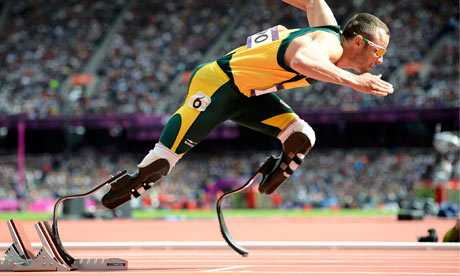
In a time where so many heroes have fallen victim to scandal (Lance Armstrong and General Petraeus come to mind), one has to wonder where they can look for inspiration. For a long time, many believed they had found that man in Oscar Pistorious, the double-amputee sprinter out of South Africa. Pistorious jumped onto the scene for most in the 2012 London Olympics, where he became simultaneously the first amputee to run in the Olympics and the first amputee to advance to the semi-finals

Immediately he became a beacon of hope to millions, and not just to amputees. Anyone with obstacles to overcome could look at Pistorious and see that anything is, in fact, possible with hard work and dedication. 

And then he murdered his girlfriend. On Valentines Day stories began to break, claiming that model Reeva Steenkamp was killed in a dispute by her boyfriend, Pistorious.

In one instant, all of what Pistorious has worked so hard to achieve throughout his lifetime was lost. And there's no one to blame but himself.

In the weeks following the atrocity, Pistorious has handled the negative publicity relatively well, claiming that while he was, in fact, the one to shoot his girlfriend, it was purely out of self-defense and not premeditated, even holding a private memorial service to honor his fallen lover.

Whether or not he is found guilty in June, when he is scheduled to appear again before court, Pistorious' reputation is forever tarnished, and begs the question: who can we look up to?
Oscar Pistorious appears before the court in his plea for bail.

Pistorious was someone you wanted to root for, someone you wanted to see succeed. He was the perfect role model, one who overcame seemingly insurmountable obstacles to achieve greatness. The one billion people living with disabilities saw a glimmer of hope, a superstar just like them. Until February 14th, when the murder charge hit home like a "punch in the stomach."

Time and time again, the public believes to have found someone they can latch on to; someone they can love and model themselves after. But more and more now, scandal is oftentimes not far behind.

Part of the problem is obviously that with increased attention, the blemishes of stars are more likely to be revealed, and their pasts will be looked into more thoroughly. But imagine how a young boy with cancer felt when he heard of Lance Armstrong's PED usage. Or what went through the mind of tens of thousands of Penn State alums when the news broke regarding Joe Paterno's link to a child abuse ring.

Fame and stardom will change people, and oftentimes not for the better. Rather than modeling yourself after an athlete or musician, look closer to home. Parents, teachers, and siblings are oftentimes more aware of the direct impact of their actions on those around them, as their scope is not as large.

Focus on the greatness of what Pistorious did. Overcoming fibular hemimelia in both legs at 11 months old, and going to on run in the Olympics is by no means any less impressive now that these charges are held against him. Bad people can still do great things, and good people can make mistakes. But in Pistorious' case, his days of providing a beacon of hope are over.

Wednesday, February 13, 2013

All Day: Is Adrian Peterson Changing the Game of Football?

Rushing Yards: 2097
Rushing Touchdowns: 12
Longest Run: 82 Yards
Torn ACL and Sports Hernia: 1, and 1, respectively

Last week, news broke that Adrian Peterson had a procedure to repair a sports hernia he began to suffer from in Week 10. That means that not only was the Vikings' running back less than a year removed from a torn anterior cruciate ligament, but he played nine games -in which he rushed for 1,239 yards- that many players would have sat out. Most people can hardly get out of bed with a sports hernia, yet Adrian Peterson was able to put together the second best season in running back history.
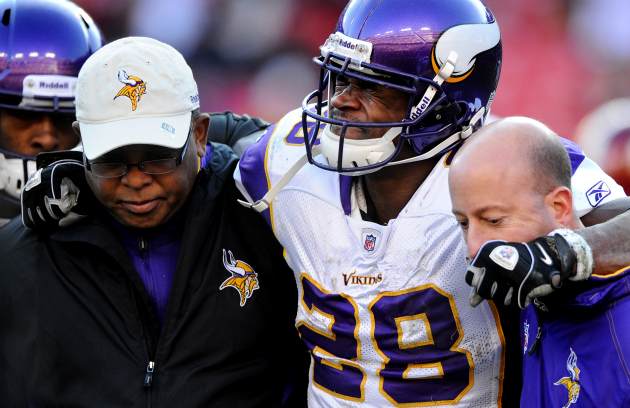
Adrian Peterson helped onto a cart after tearing his ACL on
December 24th, 2011. 

There are some, including Detroit Lions head coach Jim Schwartz, who believe Adrian Peterson is changing the way the sports looks at ACL injuries, and injuries in general. Injuring his knee in the final game of the 2011-2012 season, Peterson had surgery on December 30th, but was back on the sidelines for the Vikings' season opener at home against the Jaguars, scoring two touchdowns on 84 yards from scrimmage.

It would be one thing for Peterson to recover from his ACL in nine months rather than the year plus it takes most players. Medical procedures are advancing, and Peterson was in incredible shape to begin with. But for him to have the season he had -even his personal best by over 300 yards- is unheard of, especially when you add in the recent news of his sports hernia, therefore garnering comparisons between him and X-Men's Wolverine.
Adrian Peterson breaks a tackle from Texans' linebacker
Scott Barwin in Week 16

But Adrian Peterson is the outlier, not the norm. While yes, NFL players are more and more likely to return from injuries of this caliber than in decades past, still only 63% of players sustaining an ACL injury in 2010 were back in the game 10.8 months later.

A similar situation, Kansas City Chiefs' running back Jamaal Charles also tore his ACL in the 2010 season, the only difference being his injury occurred nearly four months prior to Peterson's, and therefore had a longer recovery period than the 2012 MVP, as well as 500 fewer rushing yards and seven fewer touchdowns.

The NFL has not seen an athlete like Adrian Peterson in a very long time, if at all. His success has defied all barriers and obstacles, and appears like it will continue for years to come. But his story of the past two seasons will not become a model for other players. Because other players are not Adrian "All Day" Peterson.


Tuesday, January 29, 2013

People Must

American: 5     People: 8
Must: 8            Work:7
Together: 1      On: 16
Our: 69            Journey: 3
To: 71              Freedom: 3

Utilizing a combination of Wordle and Microsoft Word Count, I was able to delve into the themes of last week's Inaugural Address. In noticing how frequently President Obama uses a word, it becomes easier to pick out topics that the administration feels most strongly about.

Wordle will automatically pick out filler words -the, of, on, a, but- in order to paint a more accurate picture (literally) of what is actually being said. Since size equates to usage, the most widely employed "relevant" words are therefore must, people, time, freedom, American, and journey, among a few others.

Using this information, it becomes quicker and easier to decipher what exactly Obama is trying to say with his second and final Inaugural Address.

What sets this speech apart from others similar in intent is its reliance on the word "must." An obvious rhetorical strategy, this utilization presents a sense of urgency throughout the entire speech. Rather than outlining what he would like us to do, Obama phrases his ideas in a way that makes them seem like the only option. Although very clearly a black-or-white fallacy, the President is successful in playing up the importance of sticking to the plan he has outlined for us in order to bring this country where it needs to go.

The regularity with which the words our, together, and one can be found in the text offer up the clear path of action President Obama recommends in order to better our nation and ourselves. The road to prosperity is one of unity and agreement, not partisanship and greed. This phrasing is so heavily emphasized for a reason, and that reason is to promote cooperation both across the aisle and between neighbors and friends. As for whether or not these ideals come to fruition, check back in four years.