100m, 200m, 400m: Events
0: Legs
1: Fallen Hero
In a time where so many heroes have fallen victim to scandal (Lance Armstrong and General Petraeus come to mind), one has to wonder where they can look for inspiration. For a long time, many believed they had found that man in Oscar Pistorious, the double-amputee sprinter out of South Africa. Pistorious jumped onto the scene for most in the 2012 London Olympics, where he became simultaneously the first amputee to run in the Olympics and the first amputee to advance to the semi-finals.
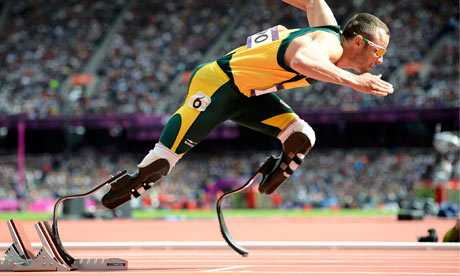
Immediately he became a beacon of hope to millions, and not just to amputees. Anyone with obstacles to overcome could look at Pistorious and see that anything is, in fact, possible with hard work and dedication.
And then he murdered his girlfriend. On Valentines Day stories began to break, claiming that model Reeva Steenkamp was killed in a dispute by her boyfriend, Pistorious.
In one instant, all of what Pistorious has worked so hard to achieve throughout his lifetime was lost. And there's no one to blame but himself.
In the weeks following the atrocity, Pistorious has handled the negative publicity relatively well, claiming that while he was, in fact, the one to shoot his girlfriend, it was purely out of self-defense and not premeditated, even holding a private memorial service to honor his fallen lover.
Whether or not he is found guilty in June, when he is scheduled to appear again before court, Pistorious' reputation is forever tarnished, and begs the question: who can we look up to?
Pistorious was someone you wanted to root for, someone you wanted to see succeed. He was the perfect role model, one who overcame seemingly insurmountable obstacles to achieve greatness. The one billion people living with disabilities saw a glimmer of hope, a superstar just like them. Until February 14th, when the murder charge hit home like a "punch in the stomach."
Time and time again, the public believes to have found someone they can latch on to; someone they can love and model themselves after. But more and more now, scandal is oftentimes not far behind.
Part of the problem is obviously that with increased attention, the blemishes of stars are more likely to be revealed, and their pasts will be looked into more thoroughly. But imagine how a young boy with cancer felt when he heard of Lance Armstrong's PED usage. Or what went through the mind of tens of thousands of Penn State alums when the news broke regarding Joe Paterno's link to a child abuse ring.
Fame and stardom will change people, and oftentimes not for the better. Rather than modeling yourself after an athlete or musician, look closer to home. Parents, teachers, and siblings are oftentimes more aware of the direct impact of their actions on those around them, as their scope is not as large.
Focus on the greatness of what Pistorious did. Overcoming fibular hemimelia in both legs at 11 months old, and going to on run in the Olympics is by no means any less impressive now that these charges are held against him. Bad people can still do great things, and good people can make mistakes. But in Pistorious' case, his days of providing a beacon of hope are over.
In one instant, all of what Pistorious has worked so hard to achieve throughout his lifetime was lost. And there's no one to blame but himself.
In the weeks following the atrocity, Pistorious has handled the negative publicity relatively well, claiming that while he was, in fact, the one to shoot his girlfriend, it was purely out of self-defense and not premeditated, even holding a private memorial service to honor his fallen lover.
Whether or not he is found guilty in June, when he is scheduled to appear again before court, Pistorious' reputation is forever tarnished, and begs the question: who can we look up to?
 |
| Oscar Pistorious appears before the court in his plea for bail. |
Pistorious was someone you wanted to root for, someone you wanted to see succeed. He was the perfect role model, one who overcame seemingly insurmountable obstacles to achieve greatness. The one billion people living with disabilities saw a glimmer of hope, a superstar just like them. Until February 14th, when the murder charge hit home like a "punch in the stomach."
Time and time again, the public believes to have found someone they can latch on to; someone they can love and model themselves after. But more and more now, scandal is oftentimes not far behind.
Part of the problem is obviously that with increased attention, the blemishes of stars are more likely to be revealed, and their pasts will be looked into more thoroughly. But imagine how a young boy with cancer felt when he heard of Lance Armstrong's PED usage. Or what went through the mind of tens of thousands of Penn State alums when the news broke regarding Joe Paterno's link to a child abuse ring.
Fame and stardom will change people, and oftentimes not for the better. Rather than modeling yourself after an athlete or musician, look closer to home. Parents, teachers, and siblings are oftentimes more aware of the direct impact of their actions on those around them, as their scope is not as large.
Focus on the greatness of what Pistorious did. Overcoming fibular hemimelia in both legs at 11 months old, and going to on run in the Olympics is by no means any less impressive now that these charges are held against him. Bad people can still do great things, and good people can make mistakes. But in Pistorious' case, his days of providing a beacon of hope are over.

What's interesting is to consider other athletes who did acts that causes a loss in trust, yet rebounded to regain that trust. One such athlete is Kobe. Kobe faced legal trouble when he was accused of raping a woman, and though he was found not guilty, his reputation was for the time tainted. But nowadays most people, at least in Chicago, go around broadcasting their hate for Lebron, while failing to feel any such hate for Kobe Bryant. And what about Tiger Woods? Despite preponderant evidence of several affairs he has had over the past years, his reputation is rebounding. And though these two athletes committed atrocities no where near as damaging as murder, they provide interesting background. Could Pistorius rebound from these murder allegations? It appears possible.
ReplyDeleteHowever, this case does make it clear that perhaps greater responsibility is necessary for all of us in choosing societal role models. The ease of a rise to fame and the subsequent rise in publicity means that any individual can quickly become a public figure, whose life then gets thrown under the public microscope. Not all individuals can take this publicity and some don't deserve the fame they so quickly got. Perhaps our state of irresponsible role models stems from our era, in which such role models are easy to come by.
I certainly see your point in that Kobe and Tiger, and you can throw Ray Lewis into that mix as well, were able to regain their stardom. But at the same time, if any of them were to achieve a major accomplishment (NBA Championship, Masters, MVP, etc.) the stories that once caused their downfall would almost certainly resurface.
ReplyDeleteIn today's world, moving beyond just athletes and celebrities, anything you say or do will be held against you for your entire life. Social media and omnipresent video cameras make it possible to keep track of years worth of interactions and decisions, which require people to constantly be vigilant as to what they let slip.
I fear for the day when someone from our generation is running for political office and critics read through their entire Facebook feed from when he or she was in eighth grade onward. What a world that will be.
Nicole was discussing a similar point in her post: http://lookthroughthemicroscope.blogspot.com/2013/02/life-exposed.html
ReplyDeleteBut I responded that this world of open knowledge and constant exposure isn't all bad. It could ultimately lead to a more responsible and conscious society, as well as prevent any future leader who had some skeleton in the closet.