100m, 200m, 400m: Events
0: Legs
1: Fallen Hero
In a time where so many heroes have fallen victim to scandal (Lance Armstrong and General Petraeus come to mind), one has to wonder where they can look for inspiration. For a long time, many believed they had found that man in Oscar Pistorious, the double-amputee sprinter out of South Africa. Pistorious jumped onto the scene for most in the 2012 London Olympics, where he became simultaneously the first amputee to run in the Olympics and the first amputee to advance to the semi-finals.
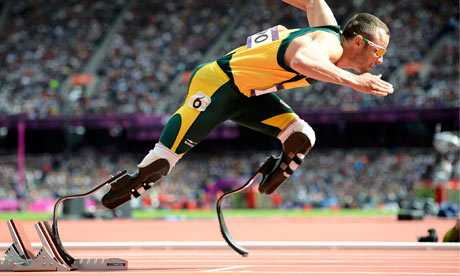
Immediately he became a beacon of hope to millions, and not just to amputees. Anyone with obstacles to overcome could look at Pistorious and see that anything is, in fact, possible with hard work and dedication.
And then he murdered his girlfriend. On Valentines Day stories began to break, claiming that model Reeva Steenkamp was killed in a dispute by her boyfriend, Pistorious.
In one instant, all of what Pistorious has worked so hard to achieve throughout his lifetime was lost. And there's no one to blame but himself.
In the weeks following the atrocity, Pistorious has handled the negative publicity relatively well, claiming that while he was, in fact, the one to shoot his girlfriend, it was purely out of self-defense and not premeditated, even holding a private memorial service to honor his fallen lover.
Whether or not he is found guilty in June, when he is scheduled to appear again before court, Pistorious' reputation is forever tarnished, and begs the question: who can we look up to?
Pistorious was someone you wanted to root for, someone you wanted to see succeed. He was the perfect role model, one who overcame seemingly insurmountable obstacles to achieve greatness. The one billion people living with disabilities saw a glimmer of hope, a superstar just like them. Until February 14th, when the murder charge hit home like a "punch in the stomach."
Time and time again, the public believes to have found someone they can latch on to; someone they can love and model themselves after. But more and more now, scandal is oftentimes not far behind.
Part of the problem is obviously that with increased attention, the blemishes of stars are more likely to be revealed, and their pasts will be looked into more thoroughly. But imagine how a young boy with cancer felt when he heard of Lance Armstrong's PED usage. Or what went through the mind of tens of thousands of Penn State alums when the news broke regarding Joe Paterno's link to a child abuse ring.
Fame and stardom will change people, and oftentimes not for the better. Rather than modeling yourself after an athlete or musician, look closer to home. Parents, teachers, and siblings are oftentimes more aware of the direct impact of their actions on those around them, as their scope is not as large.
Focus on the greatness of what Pistorious did. Overcoming fibular hemimelia in both legs at 11 months old, and going to on run in the Olympics is by no means any less impressive now that these charges are held against him. Bad people can still do great things, and good people can make mistakes. But in Pistorious' case, his days of providing a beacon of hope are over.
In one instant, all of what Pistorious has worked so hard to achieve throughout his lifetime was lost. And there's no one to blame but himself.
In the weeks following the atrocity, Pistorious has handled the negative publicity relatively well, claiming that while he was, in fact, the one to shoot his girlfriend, it was purely out of self-defense and not premeditated, even holding a private memorial service to honor his fallen lover.
Whether or not he is found guilty in June, when he is scheduled to appear again before court, Pistorious' reputation is forever tarnished, and begs the question: who can we look up to?
 |
| Oscar Pistorious appears before the court in his plea for bail. |
Pistorious was someone you wanted to root for, someone you wanted to see succeed. He was the perfect role model, one who overcame seemingly insurmountable obstacles to achieve greatness. The one billion people living with disabilities saw a glimmer of hope, a superstar just like them. Until February 14th, when the murder charge hit home like a "punch in the stomach."
Time and time again, the public believes to have found someone they can latch on to; someone they can love and model themselves after. But more and more now, scandal is oftentimes not far behind.
Part of the problem is obviously that with increased attention, the blemishes of stars are more likely to be revealed, and their pasts will be looked into more thoroughly. But imagine how a young boy with cancer felt when he heard of Lance Armstrong's PED usage. Or what went through the mind of tens of thousands of Penn State alums when the news broke regarding Joe Paterno's link to a child abuse ring.
Fame and stardom will change people, and oftentimes not for the better. Rather than modeling yourself after an athlete or musician, look closer to home. Parents, teachers, and siblings are oftentimes more aware of the direct impact of their actions on those around them, as their scope is not as large.
Focus on the greatness of what Pistorious did. Overcoming fibular hemimelia in both legs at 11 months old, and going to on run in the Olympics is by no means any less impressive now that these charges are held against him. Bad people can still do great things, and good people can make mistakes. But in Pistorious' case, his days of providing a beacon of hope are over.