Although the kingdom of
Saudi Arabia does not currently fall into Paul Collier’s “Bottom Billion,” the
nation is not inherently devoid of the traps introduced by the esteemed
economist: conflict, natural resource, landlocked, and bad governance. To best
approach the question of Saudi Arabia’s “trap involvement,” I will break up
this blog post into four sections, addressing each complexity individually.
The Conflict Trap
By Collier’s definition
(1,000 combat deaths, each side suffering at least five percent of these
deaths), Saudi Arabia has never experienced a civil war or coup. The two
principal causalities of internal conflict outlined by Collier are low initial income
and slow growth or decline. According to the World Factbook, Saudi Arabia has
the world’s 24th largest economy, with a GDP per capita that ranks
56th in the world. Although neither statistic jumps off the page,
the more important figure is Saudi Arabia’s 7.1% growth rate this previous
calendar year. Low income can be dealt with, looked at with hope for
improvement. But a depleted growth rate breeds economic despondency. As stated
by Collier, “each percentage point added to the growth rate knocks off a
percentage point from this risk [of Civil War].” This risk was minimal to begin
with, due to the state’s relative economic prosperity. But factoring in the
high rate of economic development, this possibility is almost eradicated.
Collier also discusses a
country’s dependence on exports in relation to its risk of civil war. Although
Saudi Arabia is heavily dependent on its oil industry, the government has
managed to supervise its extraction and production. Although initially providing
international companies (Texaco, Socal) a role in the industry, Saudi Arabia
has since essentially nationalized the natural resource under the
government-run Saudi Aramco, thus limiting the potential for exploitation.
The Natural Resource Trap
Depending on the day, Saudi Arabia has in its
possession the largest or second largest collection of oil reserves in the
world, controlling up to one fifth of the planets supply of this precious
natural resource. Collier argues that “over time, countries with large resource
discoveries can end up poorer.” But he goes on to mention that, “if you have
enough natural resources you can afford to forget about normal economic activity.
This is the situation in Saudi Arabia.”
Because such a large
percentage of the Saudi Arabian economy is
this oil industry (90% of the country’s exports are petroleum-based), its
prevalence on the international marketplace does not bring about the “resource
curse,” better known as “Dutch Disease,” in which the dominance of one national
industry diminishes the effectiveness of the others due to an increase in the
value of said nation’s currency.
 |
| Al-Shaybah Oil Field |
Saudi Arabia has also
proven responsible with its oil revenue, keeping expenditures to a minimum and
currently holding the sixth best budget surplus in the world at 13.8% of the GDP. Therefore, unlike Nigeria in the 1980’s, Saudi Arabia will not collapse
upon itself in the event of a drop in oil prices.
Finally, as Saudi Arabia
is a autocratic monarchy, it has been able to steer clear of the corruption
associated with democracies rich in resources. Patronage politics play no role
in the choosing of political leaders, and taxes remain relevant as they make up
50.3% of the GDP.
Landlocked With Bad Neighbors Trap
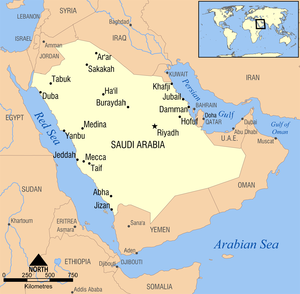 Of all the traps presented by Collier in his analysis, "Landlocked with Bad Neighbors" proves the least relevant to Saudi Arabia's situation. Not only does Saudi Arabia lie on a peninsula with 2,640 kilometers of coastline, but the Suez Canal and Strait of Aden allow Saudi Arabia to bypass its direct neighbors if it so chooses and trade with the rest of the world, which is what the nation does. In 2011, 13.9% of Saudi Arabian exports (essentially oil) went to Japan, 13.6% to China, 13.4% to the United States, 10.2% to South Korea, 7.8% to India, 4.8% to Singapore, with the remaining 36.3% scattered throughout the globe. Saudi Arabia's geography has done nothing to affect it's economic and political stature other than bless the country with an abundance of natural oil reserves. Where Saudi Arabia is located does not prevent it from interacting with any other nation in particular, and it has the infrastructure in place to be able to do this.
Bad Governance Trap
Collier argues that there exists a ceiling applicable to a country's growth rate, but no basement. Under even the most effective regimes, rarely will a nation exceed growth of 10% in one year. But poor leadership can tank an economy immediately. Since King Abdullah assumed power in 2006, only once has the economic growth rate fallen under one percent, and never has the Gross Domestic Product actually shrunk.
Given the amount of natural resources available to Saudi Arabia, the kingdom just "has to avoid doing harm rather than actively do much good." As long as the infrastructure to export commodities like oil is in place, which it is, Saudi Arabia will succeed economically.
That is not to say the monarchic system of government present in Saudi Arabia is perfect- it's not. There exists little to no religious freedom, women have been subjugated for centuries, and censorship runs rampant. But these vices do not prevent Saudi Arabia from prospering economically, and therefore this nation does not fall under the bad governance trap.
Landlocked With Bad Neighbors Trap
Bad Governance Trap
Collier argues that there exists a ceiling applicable to a country's growth rate, but no basement. Under even the most effective regimes, rarely will a nation exceed growth of 10% in one year. But poor leadership can tank an economy immediately. Since King Abdullah assumed power in 2006, only once has the economic growth rate fallen under one percent, and never has the Gross Domestic Product actually shrunk.
Given the amount of natural resources available to Saudi Arabia, the kingdom just "has to avoid doing harm rather than actively do much good." As long as the infrastructure to export commodities like oil is in place, which it is, Saudi Arabia will succeed economically.
That is not to say the monarchic system of government present in Saudi Arabia is perfect- it's not. There exists little to no religious freedom, women have been subjugated for centuries, and censorship runs rampant. But these vices do not prevent Saudi Arabia from prospering economically, and therefore this nation does not fall under the bad governance trap.

No comments:
Post a Comment